However, are these measures a true mark of success?
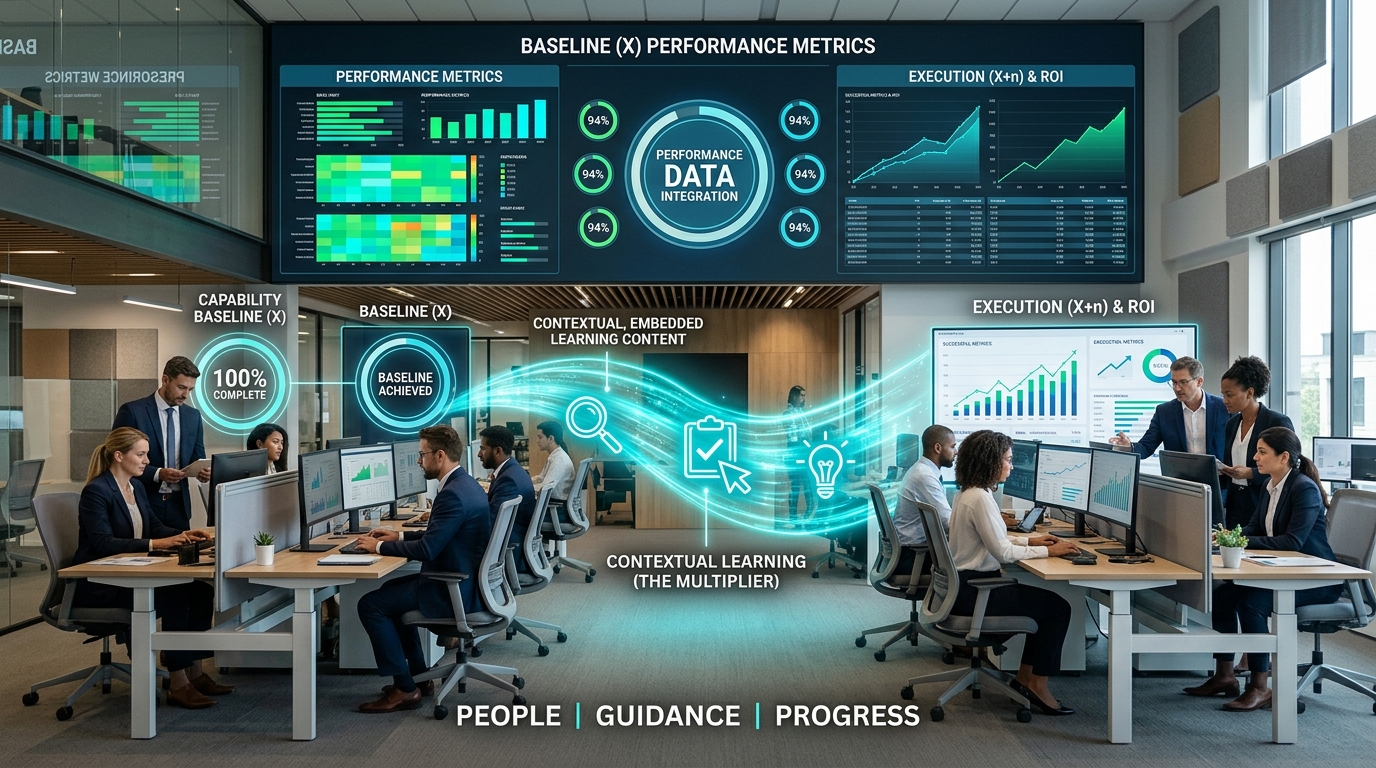
How can large organizations measure the reach and efficiency of their learning endeavors? How can they use numbers and metrics to measure the Return On Investment of their learning journeys? How can they encourage employees to bring these key learnings into their everyday work? As Peter Drucker famously said, "If it cannot be measured, it cannot be managed." The same should hold true for learning as well. In this article, we put together 8 key aspects that can be studied over time to understand the true performance of your L&D projects.
Peter Senge’s systems thinking approach is widely known and often under-implemented. Several organizations start with a bottom-up approach to systems thinking, waiting for the details to fall into place before developing the framework that could support them. Tracking how frequently and effectively new systems and operational frameworks are adopted is a prime indicator of systemic learning.
In his widely popular book, Atomic Habits, author James Clear highlights how a change in identity is the key to changing habits. For example, saying, “I quit smoking” has a vastly different psychological impact on the quitter than saying, “I do not smoke.”
This subtle shift can also be used as a way to qualitatively measure how often learning and insights from interventions are brought into the real world. Results are visible in questions like:
Inquiry Habits: How often do workers search for and absorb information they do not understand? High-Value Discussions: How many high-value, strategic questions get asked in cross-functional meetings? Psychological Safety: How comfortable do people feel asking for and providing help in areas that are strictly outside their daily scope? When deploying a new learning intervention, organizations and learning partners must map out clear goals and outcomes. Asking, “Why do we need this intervention now?” and drilling down until at least three core reasons are uncovered is the most effective way to define metrics.
Every goal also requires a timeline. In our experience, learning interventions take at least six months to become deeply ingrained processes within organizations. Mapping each goal to a timeline clarifies when and how to measure success.
Analog Devices, a semiconductor manufacturer, implemented the half-life curve to measure learning efficacy as part of their Total Quality Management (TQM) process. The half-life curve represents the time taken to achieve a 50% improvement in a target process.
For example, if an organizational goal from a training intervention is reducing customer churn from 20% YoY to 10% YoY, introducing a targeted learning program and measuring churn at the 3-month and 6-month marks provides concrete quantitative telemetry on performance acceleration.
Linear Model: Problem → Learning Intervention → Solution Double-Loop Model: Problem → Learning Intervention → Outcome → Learning From Outcomes → Solution Creating feedback loops ensures that as new organizational challenges emerge, the training program dynamically iterates based on real-world outcomes rather than static theory.
While systems-level metrics are comprehensive, individual-level metrics provide direct operational signals:
Non-Mandatory Completion: If 6,000 out of 10,000 employees complete an optional training module, this establishes an organizational benchmark (e.g., aiming for 70%+ adoption). Completion Velocity: For mandatory training, tracking when employees log in reveals engagement health. If workers rush through modules in the final 48 hours, it signals a need for better buy-in and more engaging formats. One of the clearest ways to measure success is linking learning directly to individual and team performance metrics. When setting annual goals, leaders can identify specific learning pathways tailored to accelerate the exact competencies required for those KPIs.
Pinpoints content bottlenecks, confusing instructional design, or overly dense text. Clarifies if drop-offs correlate with seasonal business cycles (e.g., quarter-end pressure), allowing L&D teams to optimize deployment scheduling. Conclusion: Making L&D Measurable
It is essential for forward-thinking organizations to treat Learning and Development as an accountable, measurable driver of employee morale, retention, and bottom-line growth. Establishing clear metrics before launching training initiatives ensures your investments yield tangible, transformative results.