Dynamic research, video walkthroughs, and comprehensive case study reports for enterprise digital adoption, micro-learning, and continuous enablement.
Article
4 min read
Aruna•Oct 8, 2026
The AI Content Trap: Faster Course Creation is Not Workforce Enablement
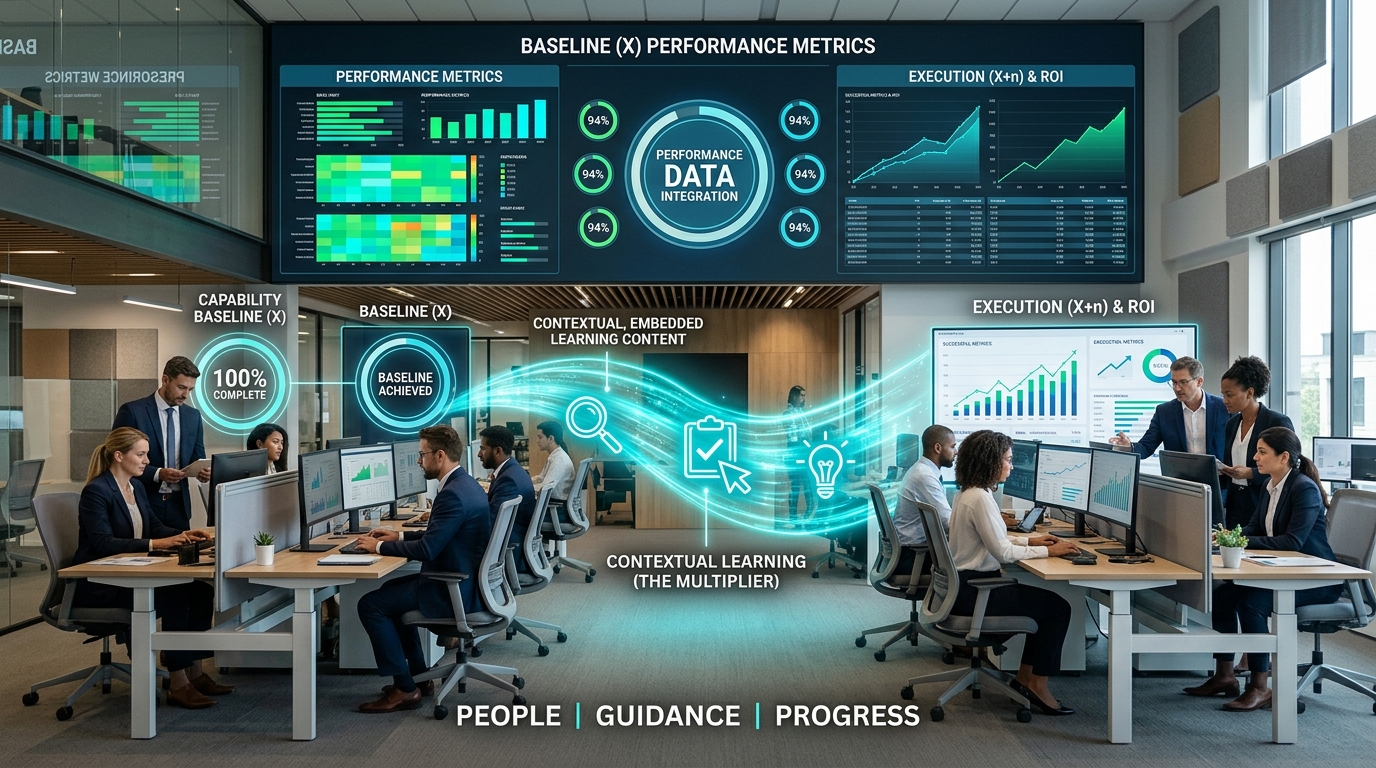
Generative AI has shifted workplace learning from content scarcity to absolute abundance, but pumping out courses faster does not drive capability. Discover why modern corporate enablement prioritises contextual workflow integration over rapid course generation.
Contextual
Enablement Model
In-Flow
Workflow Friction Deflection
Article
4 min read
Sanjeev M•Sep 10, 2026
Beyond Training Completion: Bridging the Performance-Support Gap
High training completion rates on a new ERP, CRM, or HR system do not guarantee that employees can successfully use software in the flow of work. Discover why enterprise digital transformation requires purposeful performance support to turn baseline DAP capability into sustained execution.
86.3%
Contextual Adoption (M12)
57.2%
Baseline Growth (M12)
Article
4 min read
Aruna•Aug 17, 2026
The Execution Gap: The Missing Link in Digital Transformation
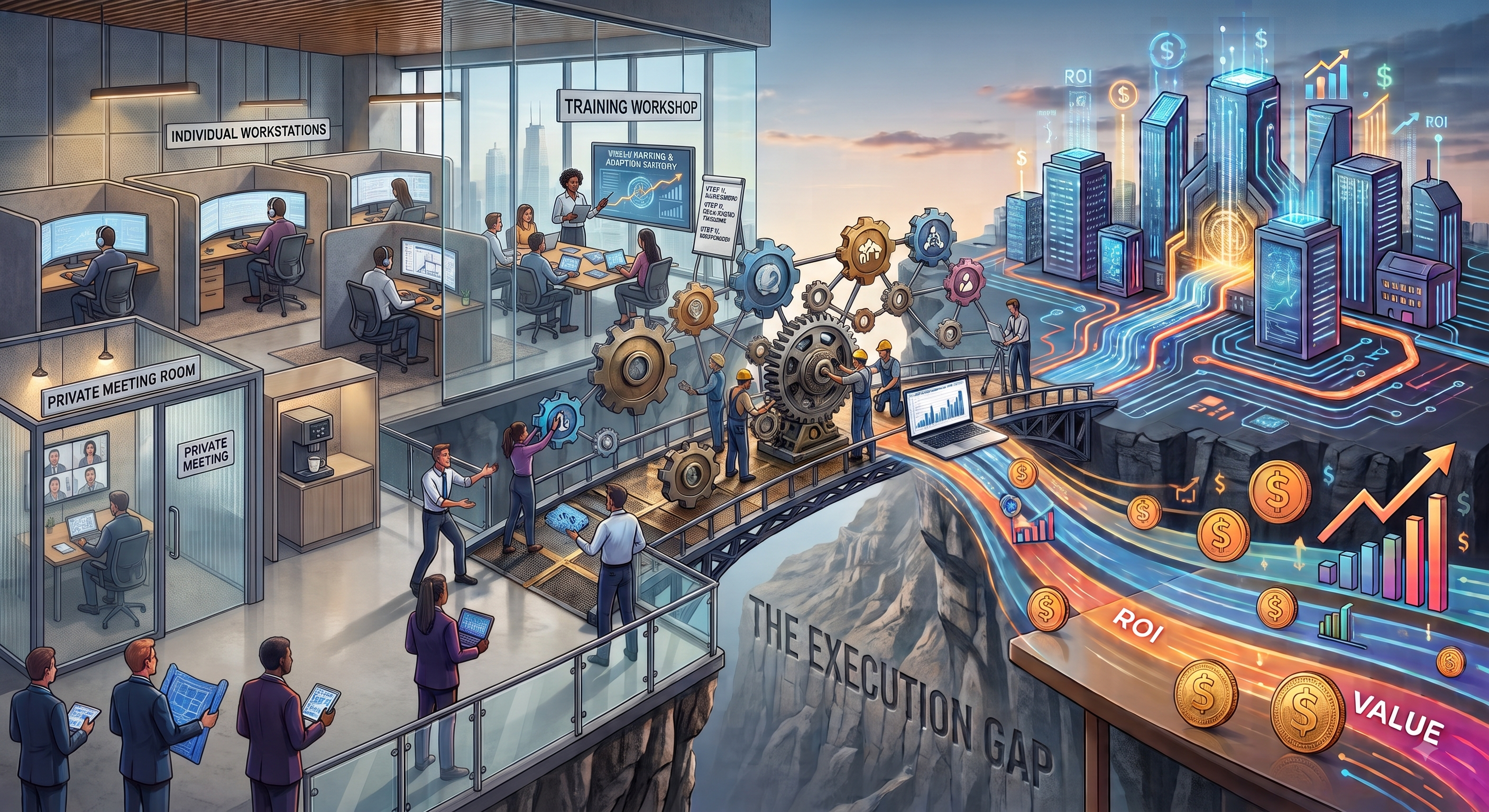
Industry data consistently shows that up to 70% of enterprise strategic transformations fail to achieve their promised goals. Discover how continuous role-based enablement closes the Execution Gap.
Video
Video Demo
Dexler Solutions Team•Feb 17, 2026
SAP Material Management Course
Live demonstration and walkthrough of SAP Materials Management (MM) and digital adoption workflows across enterprise procurement and inventory logistics.
68%
Error Reduction
3.2x
Workflow Speed
Video
Video Briefing
Dexler Learning Strategy•Feb 15, 2026
Evolution of L&A
Strategic briefing exploring the evolution of Learning & Adoption (L&A) models from traditional training events to contextual, continuous capability building.
-54%
Time-to-Proficiency
4.1x
Knowledge Retention
Video
Video POC
Dexler Security Practice•Feb 12, 2026
Digital Security in The Banking Sector
Proof-of-concept demonstration on embedding verifiable digital security safeguards, access governance, and compliance guidance into core banking transactions.
100%
Compliance Adherence
0
Security Incidents
Video
Video Case Study
Dexler Enterprise Team•Feb 09, 2026
Enterprise SAP Enablement: Insurance
A leading insurance and banking organization partnered with Dexler to accelerate workforce readiness and user adoption during its SAP Cloud transformation. Dexler delivered learning needs analysis, localized SAP content, simulations, work instructions, train-the-trainer, and end-user enablement aligned to the implementation and go-live roadmap.
-45%
Claims Cycle Time
5 Wks Saved
Adjuster Ramp-up
Case Study
PDF Business Case Study
Dexler Enterprise Team•Jan 18, 2026
Accelerating SAP Ariba Adoption Through Digital Workforce Enablement
Discover how a leading global banking group navigated the people and adoption challenges of a major SAP Ariba transformation. Dexler combined digital learning, in-app guidance, and a hybrid delivery model to help users transition to new ways of working while building lasting internal enablement capability.
Driving Workforce Readiness Through Role-Based Learning for a Leading Oil & Gas Company
Discover how a leading Oil & Gas organization approached workforce readiness during a large-scale SAP transformation. Dexler helped connect business roles with learning needs and established a scalable approach to end-user enablement and continuous learning.
Micro-learning Or Traditional Courses - Why Not Have Both?
When we hear the word Micro-learning, the obvious picture that comes into mind is of small bite-size mobile learning modules, which cover a few seconds to a few minutes. The Microlearning process is mostly related to...
Article
3 min read
Sruthy Satyanath•Mar 9, 2021
Micro-Learning To Overcome Skills Training Challenges And Enhance L&D
Being in a need-specific and super busy world, learning has to be concise, crisp, bite-sized, and accessible from anywhere, anytime. Micro-learning feeds the learners with information through short courses and modules.
Article
6 min read
Sanjeev M•Mar 2, 2021
Personalisation vs. Standardisation: Here's How To Have Both, For Better Learning Outcomes
Very often, when we think of training, we're thinking about custom training processes. Training, especially one involving eLearning content, at the organisational level often involves -planning the annual calendar
Article
3 min read
Seema Sharma•Feb 23, 2021
How To Create An Effective Design Document
Developing an effective training course requires planning, strategy, coordination, and a roadmap to guide through each step of the process, such as storyboarding, visualizing, developing, etc. This roadmap or guide is...
Article
3 min read
Sruthy Satyanath•Feb 16, 2021
Personalized learning: A paradigm shift in the employee learning and development model in 2021
Most organisations typically follow the “one-size-fits-all’ model of knowledge transfer for their employees. This method, however, is inherently flawed. Often, a few among the group excel in grasping the process and i...
Article
3 min read
Seema Sharma•Feb 9, 2021
Know-How Nuggets - #1. Articulate Storyline: A How-To Guide
The need to have a well-entrenched training and learning culture is of great importance in today’s world, where organizations face frequent waves of upgraded technology, skills advancement, and a hyper-competitive env...
Article
7 min read
Antara M•Feb 2, 2021
Learning In The Time Of Corona- Current Challenges And Opportunities for Enterprise Digital Learning
Covid-19 . This one word is enough to instill a lot of distress among us. Our life as we knew it, changed a lot of direction. We endured the global pandemic and came up with a lifestyle that we never thought was possi...
Article
3 min read
Sanjeev M•Jan 19, 2021
Designing your L&D budget? Here’s what you can’t afford to miss
Learning and development (L&D) have always been a part of the workplace ecosystem per se. What varies is how it is executed. From conference rooms filled with teams to offsites and team activities to online modules, the L&D modes are many.
Article
4 min read
Sanjeev M•Jan 19, 2021
Here's How Zoom Revived The Digital Learning Industry, And Where To Go Next
When it comes to a global pandemic, it is hard to look at the bright side. However, that's precisely what we must do to move forward as a collective. The economic impact on offline learning has been harsh in the post-pandemic world.
Article
4 min read
Dexler Education•Oct 6, 2020
How Development Mapping Works In L&D
A development map is an indispensable tool in the learning and development (L&D) training industry, particularly for organizations looking for elements of customization in their training material. The best-designed development maps balance and integrate high-level business goals with individual employee needs.
Article
7 min read
Dexler Education•Oct 6, 2020
How To Measure The Quality Of Your Organizational Learning Endeavors
Learning at scale takes different forms, from offline, or even offsite, training interventions to content delivered and completed digitally. For a long time, however, the role of learning has been relegated to the com...
Article
4 min read
Dexler Education•Oct 6, 2020
Using Digital Learning To Prevent Burnout At The Workplace
Over the years, “Burn-out” was a term associated with the level of stress people underwent. Now, the World Health Organization (WHO) has included its new definition of the term in the International Classification of Diseases diagnostic manual.
/Article/Micro-learning Or Traditional Courses - Why Not Have Both?
ArticleMar 24, 2021
Micro-learning Or Traditional Courses - Why Not Have Both?
A
Antara M 7 min read
Executive Overview
When we hear the word Micro-learning, the obvious picture that comes into mind is of small bite-size mobile learning modules, which cover a few seconds to a few minutes. The Microlearning process is mostly related to...
Targeted, just-in-time, engaging, retention-boosting, cost-effective, and easy deployment options make microlearning a natural fit for today's fast-paced lifestyle of the learners, who are well equipped with the latest technology of the modern world.
On the other hand, conventional and traditional online courses are considered to be lengthy and time-consuming. So does that mean we leave the long hours of learning and training in the past and move towards shorter hours of knowledge gathering? Well, not necessarily.
We can still opt for traditional online education, but with a 'Micro-learning' touch
In a world that is constantly progressing, learning and development are sure to evolve. As the lifestyle is becoming fast-paced, learning is becoming quicker as well, hence microlearning is the need of the hour.
However, we cannot ignore the fact that conventional or traditional learning is equally, if not less effective, to date. We still need longer, full-time courses in areas such as training and development, employee up-gradation on a business process, or while teaching a core subject-related topic.
That being said, we might not always get the required time to sit in front of a computer and take in hours and hours of training at one go. This is where the microlearning strategy comes in.
Why blend Micro-learning with traditional courses?
The change in education around the globe is driven by breakthrough researches on how the brain functions and how people learn. You will be surprised to know that a human brain can only take in a maximum of five new pieces of information at a time before we get overloaded, and further new knowledge gets lost in the depth of what psychologists refer to as the "Ebbinhauser Forgetting Curve".
The simplest solution to avoid information overload would be to break the large size down.
It is a known fact that your employees are already juggling multiple responsibilities (work deliverables, professional growth, personal commitments, etc). This makes their attention span shorter and thus learning and development courses with larger hours may not appeal to them.
However, breaking down, let's say, a 2-day long course into smaller 3 to 5 minutes learning nuggets makes it easier to consume. The use of 'micro content', delivered in a variety of modes, keeps your learners engaged and cater to different learning styles. This brings us to an important question,
Does converting traditional courses to micro-learning just mean breaking them into smaller chunks?
Well, though many might seem to think that way, converting your conventional courses into micro-learning, is more than just a matter of chunking materials into smaller nuggets.
Micro-learning is a learning strategy that is applied while breaking down bigger content into smaller nuggets. Each microlearning nugget deals with one learning objective, with a duration of a few seconds to a few minutes, which is precise enough for your learners to consume and use to upgrade their job performance.
Let us delve a little deeper to see how micro-learning can be implemented in your learning and development space.
How is micro-learning implemented?
Before converting any course into micro-learning it is necessary to understand that simple slicing of a large-sized online or ILT content into smaller chunks will only make a smaller course. The content might not be suitable to the learners or it might not solve their purpose of learning. A proper transition of bigger learning modules into bite-sized learning nuggets requires a proper instructional strategy. Let us see a step-by-step process in which microlearning can be implemented in traditional online courses.
Steps involved in implementing micro-learning to traditional courses
ANALYSIS OF YOUR EXISTING CONTENT
Analyze your learning content and find out the modules and topics that should be converted into multiple, short bite-sized nuggets, instead of hour-long online learning sessions. This is important because having distinct bite-sized chunks of content will help learners pinpoint specific pain points or knowledge gaps.
Various types of training can be delivered through micro-learning. A few examples are:
Software training
Softskill training
Health and Safety training
Compliance training
Employee onboard training
However, only micro-learning may not always be the ideal answer for your training and development program, especially when you require your learner to learn complex skills and processes, or when you need to provide hands-on-practice sessions for them. For such instances, you can go for a fusion of micro and macro learning.
How to use a blend of micro-learning and traditional learning?
You can use the micro-learning format along with your conventional learning method to create a holistic learning experience. You can use this approach during the following stages of employee learning:
Pre-training
You can introduce the prerequisites and the basic concepts of training via short and interactive micro-learning videos to give a heads up of the succeeding e-learning modules.
During training
You can embed micro-learning elements such as bite-size interactive infographics, interactive PDFs, eBooks and Flipbooks, animated videos, webcasts and podcasts, interactive parallax-based scrolling, complex branching scenarios, etc. in your conventional learning module to give a rich and engaging learning experience to your learners.
Post-training
Assessment Q&A after the training modules can be converted into micro assessment modules to assess the performance of your learners. Conventional simulations can be converted into micro-sized "How-to" videos to provide that extra step of assistance and explanation.
2ONBOARDING YOUR STAKEHOLDERS, SUBJECT MATTER EXPERTS (SMEs) AND DEVELOPMENT TEAM
Developing a conventional course in a micro-learning way requires a lot of team effort. So, it is always wise to involve your stakeholders, SMEs, and developing team in the process.
Here are the insights they can provide you with:
Your stakeholders will be able to provide you with information like course objective, target audience, course duration, the conditions and criteria to develop the course, the type of content, and the type of e-learning platform the course needs to be deployed on.
Your SMEs have first-hand experience in the related domain and thus, can provide you with valuable suggestions on the instructional part. They can also help out with instructions to the development team.
Your development team should have a sound knowledge of the tools and techniques required to develop the necessary microlearning assets, to be plugged in the e-learning courses.
3
SELECTING THE APPROPRIATE MICRO-LEARNING ASSET
Chopping down a lengthy course into a smaller size does not make it interesting and engaging if you do not use the correct micro-learning assets.
What micro-learning assets can you use in your traditional courses?
Depending upon their role and strength, you can use an array of micro-learning assets in your conventional e-learning course to make it a more engaging, interactive, and coherent learning experience.
A few examples of such assets are:
Infographics
Infographics provide information at a glance. They are mostly used to summarize the key takeaways from a module or a lesson.
Interactive PDFs
A makeover of the traditional PDFs, interactive ones allow longer reams of data (such as a compilation of text, images, graphics, videos) to be grouped into meaningful packages.
Animated videos
A video can be used as a standalone nugget or it can be part of a micro-learning chunk, thus providing a blended learning experience. It is mostly used to provide a visual demonstration or a step-by-step procedure of a particular task.
Podcasts
Podcasts can be used to provide information in the form of audio snippets. they are a good alternative to video and textual information when you don't have the opportunity to hold your device in front of your eyes.
Scenarios
This micro-learning asset is mostly used in the assessments to encourage performance-based learning in learners. The use of real-life scenarios challenges the learners to use critical thinking and skill to complete a task.
As we can see, there is no need to create a micro-learning course from a scratch. You can redesign your existing conventional course in a micro-learning format. It can also be developed as bite-sized nuggets that are part of a larger content. So, to conclude, it is not always required to choose between the conventional and the micro-learning option. You can just have a blend of both and the fruit will just be twice as sweet.