Dynamic research, video walkthroughs, and comprehensive case study reports for enterprise digital adoption, micro-learning, and continuous enablement.
Article
4 min read
Aruna•Oct 8, 2026
The AI Content Trap: Faster Course Creation is Not Workforce Enablement
Generative AI has shifted workplace learning from content scarcity to absolute abundance, but pumping out courses faster does not drive capability. Discover why modern corporate enablement prioritises contextual workflow integration over rapid course generation.
Contextual
Enablement Model
In-Flow
Workflow Friction Deflection
Article
4 min read
Sanjeev M•Sep 10, 2026
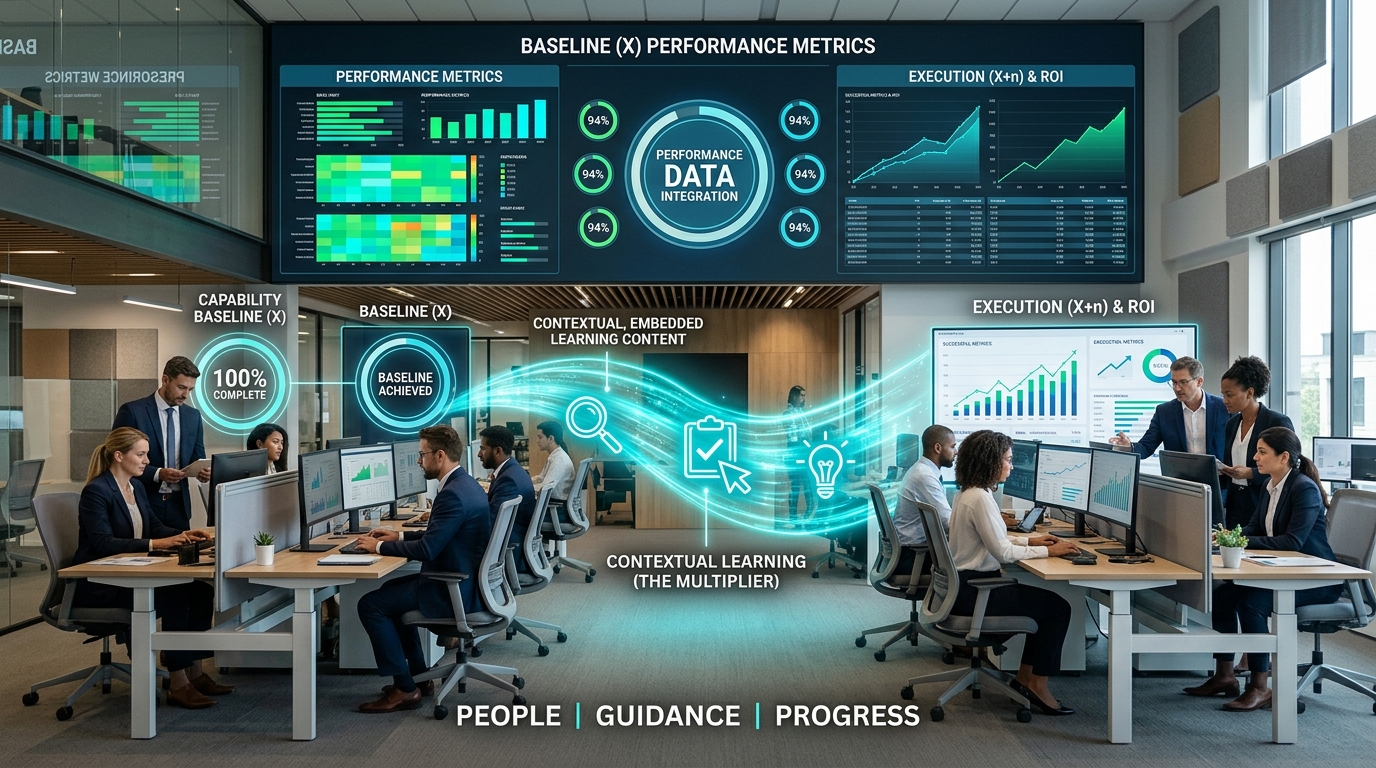
Beyond Training Completion: Bridging the Performance-Support Gap
High training completion rates on a new ERP, CRM, or HR system do not guarantee that employees can successfully use software in the flow of work. Discover why enterprise digital transformation requires purposeful performance support to turn baseline DAP capability into sustained execution.
86.3%
Contextual Adoption (M12)
57.2%
Baseline Growth (M12)
Article
4 min read
Aruna•Aug 17, 2026
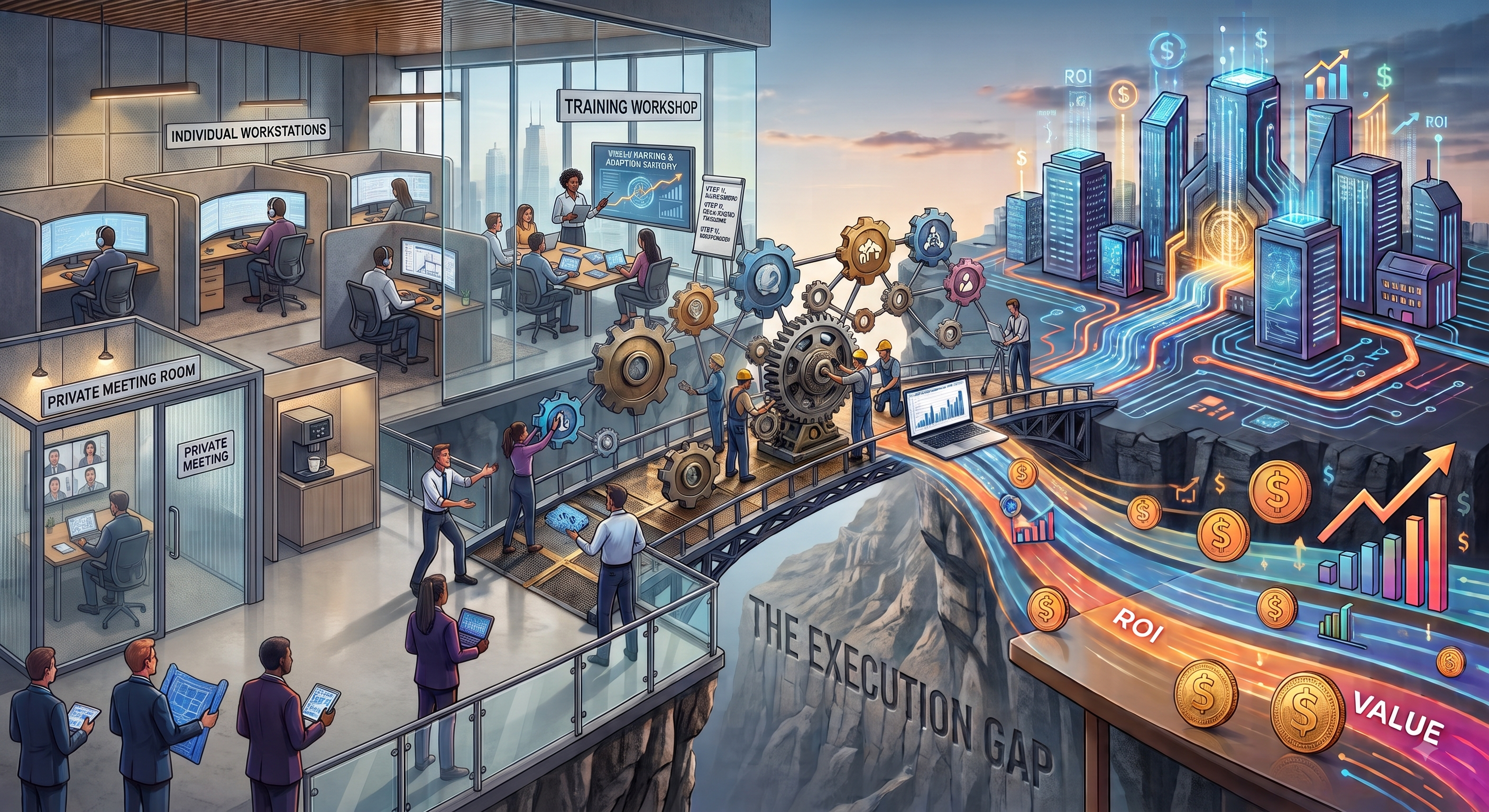
The Execution Gap: The Missing Link in Digital Transformation
Industry data consistently shows that up to 70% of enterprise strategic transformations fail to achieve their promised goals. Discover how continuous role-based enablement closes the Execution Gap.
Video
Video Demo
Dexler Solutions Team•Feb 17, 2026
SAP Material Management Course
Live demonstration and walkthrough of SAP Materials Management (MM) and digital adoption workflows across enterprise procurement and inventory logistics.
68%
Error Reduction
3.2x
Workflow Speed
Video
Video Briefing
Dexler Learning Strategy•Feb 15, 2026
Evolution of L&A
Strategic briefing exploring the evolution of Learning & Adoption (L&A) models from traditional training events to contextual, continuous capability building.
-54%
Time-to-Proficiency
4.1x
Knowledge Retention
Video
Video POC
Dexler Security Practice•Feb 12, 2026
Digital Security in The Banking Sector
Proof-of-concept demonstration on embedding verifiable digital security safeguards, access governance, and compliance guidance into core banking transactions.
100%
Compliance Adherence
0
Security Incidents
Video
Video Case Study
Dexler Enterprise Team•Feb 09, 2026
Enterprise SAP Enablement: Insurance
A leading insurance and banking organization partnered with Dexler to accelerate workforce readiness and user adoption during its SAP Cloud transformation. Dexler delivered learning needs analysis, localized SAP content, simulations, work instructions, train-the-trainer, and end-user enablement aligned to the implementation and go-live roadmap.
-45%
Claims Cycle Time
5 Wks Saved
Adjuster Ramp-up
Case Study
PDF Business Case Study
Dexler Enterprise Team•Jan 18, 2026
Accelerating SAP Ariba Adoption Through Digital Workforce Enablement
Discover how a leading global banking group navigated the people and adoption challenges of a major SAP Ariba transformation. Dexler combined digital learning, in-app guidance, and a hybrid delivery model to help users transition to new ways of working while building lasting internal enablement capability.
Driving Workforce Readiness Through Role-Based Learning for a Leading Oil & Gas Company
Discover how a leading Oil & Gas organization approached workforce readiness during a large-scale SAP transformation. Dexler helped connect business roles with learning needs and established a scalable approach to end-user enablement and continuous learning.
Micro-learning Or Traditional Courses - Why Not Have Both?
When we hear the word Micro-learning, the obvious picture that comes into mind is of small bite-size mobile learning modules, which cover a few seconds to a few minutes. The Microlearning process is mostly related to...
Article
3 min read
Sruthy Satyanath•Mar 9, 2021
Micro-Learning To Overcome Skills Training Challenges And Enhance L&D
Being in a need-specific and super busy world, learning has to be concise, crisp, bite-sized, and accessible from anywhere, anytime. Micro-learning feeds the learners with information through short courses and modules.
Article
6 min read
Sanjeev M•Mar 2, 2021
Personalisation vs. Standardisation: Here's How To Have Both, For Better Learning Outcomes
Very often, when we think of training, we're thinking about custom training processes. Training, especially one involving eLearning content, at the organisational level often involves -planning the annual calendar
Article
3 min read
Seema Sharma•Feb 23, 2021
How To Create An Effective Design Document
Developing an effective training course requires planning, strategy, coordination, and a roadmap to guide through each step of the process, such as storyboarding, visualizing, developing, etc. This roadmap or guide is...
Article
3 min read
Sruthy Satyanath•Feb 16, 2021
Personalized learning: A paradigm shift in the employee learning and development model in 2021
Most organisations typically follow the “one-size-fits-all’ model of knowledge transfer for their employees. This method, however, is inherently flawed. Often, a few among the group excel in grasping the process and i...
Article
3 min read
Seema Sharma•Feb 9, 2021
Know-How Nuggets - #1. Articulate Storyline: A How-To Guide
The need to have a well-entrenched training and learning culture is of great importance in today’s world, where organizations face frequent waves of upgraded technology, skills advancement, and a hyper-competitive env...
Article
7 min read
Antara M•Feb 2, 2021
Learning In The Time Of Corona- Current Challenges And Opportunities for Enterprise Digital Learning
Covid-19 . This one word is enough to instill a lot of distress among us. Our life as we knew it, changed a lot of direction. We endured the global pandemic and came up with a lifestyle that we never thought was possi...
Article
3 min read
Sanjeev M•Jan 19, 2021
Designing your L&D budget? Here’s what you can’t afford to miss
Learning and development (L&D) have always been a part of the workplace ecosystem per se. What varies is how it is executed. From conference rooms filled with teams to offsites and team activities to online modules, the L&D modes are many.
Article
4 min read
Sanjeev M•Jan 19, 2021
Here's How Zoom Revived The Digital Learning Industry, And Where To Go Next
When it comes to a global pandemic, it is hard to look at the bright side. However, that's precisely what we must do to move forward as a collective. The economic impact on offline learning has been harsh in the post-pandemic world.
Article
4 min read
Dexler Education•Oct 6, 2020
How Development Mapping Works In L&D
A development map is an indispensable tool in the learning and development (L&D) training industry, particularly for organizations looking for elements of customization in their training material. The best-designed development maps balance and integrate high-level business goals with individual employee needs.
Article
7 min read
Dexler Education•Oct 6, 2020
How To Measure The Quality Of Your Organizational Learning Endeavors
Learning at scale takes different forms, from offline, or even offsite, training interventions to content delivered and completed digitally. For a long time, however, the role of learning has been relegated to the com...
Article
4 min read
Dexler Education•Oct 6, 2020
Using Digital Learning To Prevent Burnout At The Workplace
Over the years, “Burn-out” was a term associated with the level of stress people underwent. Now, the World Health Organization (WHO) has included its new definition of the term in the International Classification of Diseases diagnostic manual.
/Article/Personalisation vs. Standardisation: Here's How To Have Both, For Better Learning Outcomes
ArticleMar 2, 2021
Personalisation vs. Standardisation: Here's How To Have Both, For Better Learning Outcomes
S
Sanjeev M 6 min read
Executive Overview
Very often, when we think of training, we're thinking about custom training processes. Training, especially one involving eLearning content, at the organisational level often involves -planning the annual calendar
-planning the annual calendar
-a training needs analysis process (TNA) for every training requirement
Custom content build
-Corrections and adjustments made to content
-All of this effort, with often missing metrics on how many people actually consumed the module, or found it useful.
Sometimes, because of the sheer effort involved, we are invested in the process, and believe that custom content is good. Because it is designed and developed for our specific need. Because it is unique to us.
And as an extension, any standard offering, one that's purchased off-the-shelf, is bad.
However, I'm here to debunk that idea today. I've spend the past 13 years in the business of eLearning content, and if there's one thing I've learnt and experienced myself, it is this:
Personalised content is not the opposite of standard content.
Why is that? Let's delve into the details.
Many of us have the misconception that standardized content can only deliver the basics.
Indeed, the impact of training with context drives your team, and therefore your organization, to great heights. It reflects in their productivity, enhanced skillset, motivation, overall engagement and even your employee attrition rates.
A standardised offering, we know now, can also provide most of the benefits of personalisation, without the effort involved in building custom content.
This is particularly effective when the core topic being trained on is universal- it could be an ERP solution that the whole world uses, or it could be a more generic module meant to develop a core skill.
For example, as we build Espresso by Dexler Education, we're operating with the knowledge that most businesses have similar challenges and opportunities in implementing SAP, and therefore the content used to train and empower them can be standardised to a great extent.
Suggested Reading
3 Ways For You To Make SAP End-User Enablement Faster In 2021
The Fusion of Personalised Learning with Standardisation
Every organisation craves outcomes. The role of the L&D team is complicated; on the one hand they must ensure the training is within a set budget and on the other, they must ensure the content is easily consumed by the teams (because the reality is that team members are always occupied with project deliverables)
In other words, clocking in extra hours to complete a training module should be worth their time and energy.
How can you do it?
Should you go with standards learning program or personalised or customised ones?
Let us look at two question:
Does your learning content get updated frequently (quarterly/half yearly/yearly)?
How many learning programs does the organisation/business unit conduct on average?
Most of the organisations have learning content that is updated frequently. There is a very small portion of the training that is unique and must be customised. The ratio would look something like this:
>70% - frequently updated
<30% - customised
For the training content that gets updated frequently, you can use standardised content with personalisation in terms of the context set and examples provided. The benefit here is that in choosing standard content, the onus is on your learning partner to keep their content up to date- and you don't have to worry about this, or spend more money on it.
Adding a Touch of Personalisation
Personalisation does not mean building a unique training program- this is what we often get wrong about the process.
Personalisation is not a process to be undertaken, but an outcome to be expected. In other words, when content is effective and it meets the team member where they are at, that is true personalisation.
A simple analogy would be the cakes we buy. One does not always buy a custom cake for every occasion. Instead, we buy a known flavour, and give it a new touch (the messaging on top, the colour of the frosting, and so on).
Likewise, one does not always need to build the cake that is a an eLearning module from scratch, only to have it become obsolete soon. Instead, a standard eLearning offering can be purchased, and extensions such as industry-specific examples, business process knowledge, and even your branding colours, can be added to it.
If you add too much of the flavour, the essence/context gets diluted; if the flavour is too less, you will not see the powerful impact of personalisation. Therefore, the right flavour and right amount of it is very important.
Standardised eLearning content delivered with personalisation, and the required touch of customisation, can turn the module into one that is extremely learner-friendly, while also letting you enjoy the benefits of less day-to-day involvement in content building, and shorter timelines in getting the eLearning content you need immediately.