Insights

Dynamic research, video walkthroughs, and comprehensive case study reports for enterprise digital adoption, micro-learning, and continuous enablement.

The AI Content Trap: Faster Course Creation is Not Workforce Enablement
Article
4 min read
Aruna•Oct 8, 2026

The AI Content Trap: Faster Course Creation is Not Workforce Enablement

Generative AI has shifted workplace learning from content scarcity to absolute abundance, but pumping out courses faster does not drive capability. Discover why modern corporate enablement prioritises contextual workflow integration over rapid course generation.

Contextual
Enablement Model
In-Flow
Workflow Friction Deflection
Beyond Training Completion: Bridging the Performance-Support Gap
Article
4 min read
Sanjeev M•Sep 10, 2026

Beyond Training Completion: Bridging the Performance-Support Gap

High training completion rates on a new ERP, CRM, or HR system do not guarantee that employees can successfully use software in the flow of work. Discover why enterprise digital transformation requires purposeful performance support to turn baseline DAP capability into sustained execution.

86.3%
Contextual Adoption (M12)
57.2%
Baseline Growth (M12)
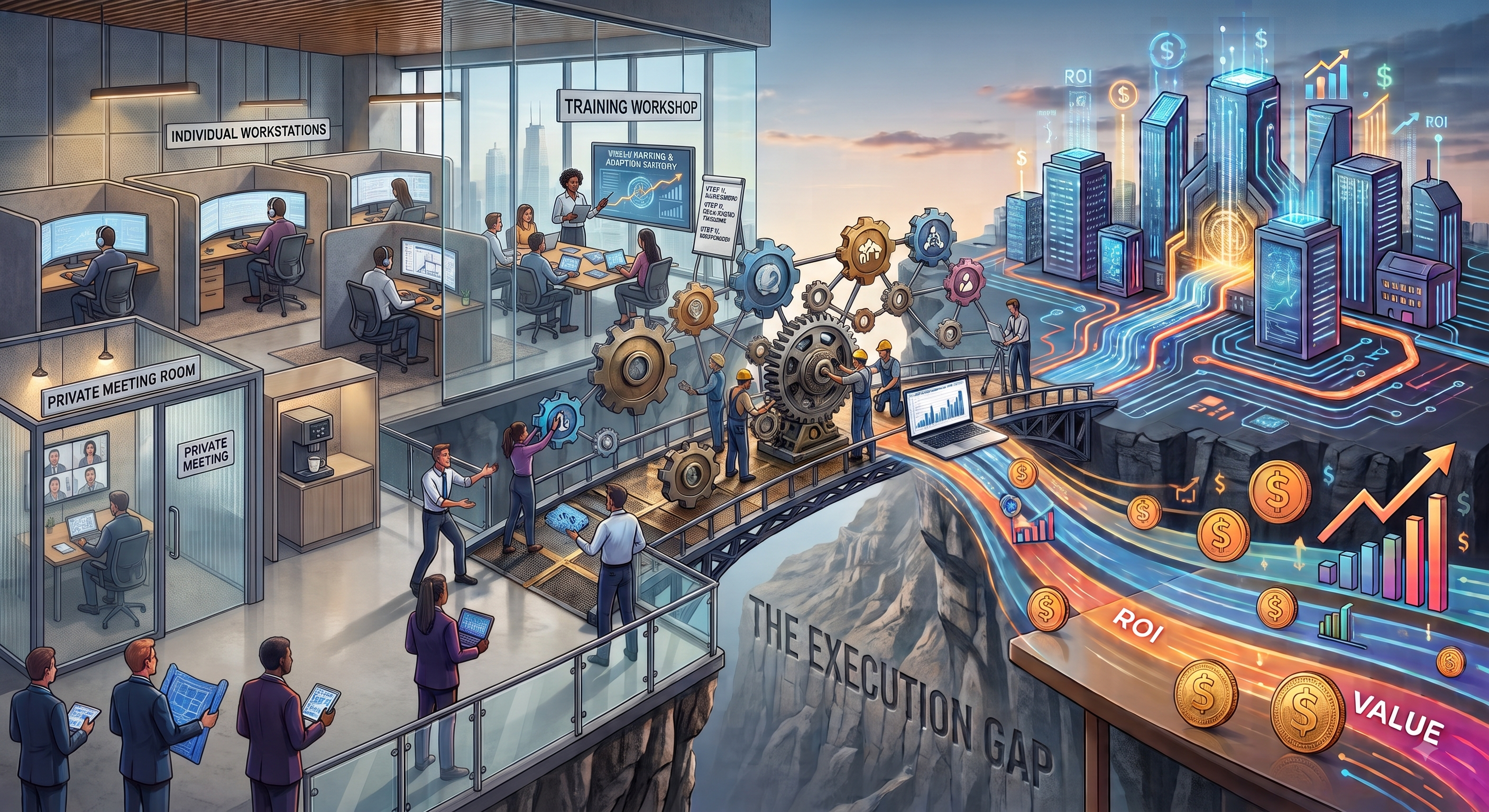
The Execution Gap: The Missing Link in Digital Transformation
Article
4 min read
Aruna•Aug 17, 2026

The Execution Gap: The Missing Link in Digital Transformation

Industry data consistently shows that up to 70% of enterprise strategic transformations fail to achieve their promised goals. Discover how continuous role-based enablement closes the Execution Gap.

Video
Video Demo
Dexler Solutions Team•Feb 17, 2026

SAP Material Management Course

Live demonstration and walkthrough of SAP Materials Management (MM) and digital adoption workflows across enterprise procurement and inventory logistics.

68%
Error Reduction
3.2x
Workflow Speed
Video
Video Briefing
Dexler Learning Strategy•Feb 15, 2026

Evolution of L&A

Strategic briefing exploring the evolution of Learning & Adoption (L&A) models from traditional training events to contextual, continuous capability building.

-54%
Time-to-Proficiency
4.1x
Knowledge Retention
Video
Video POC
Dexler Security Practice•Feb 12, 2026

Digital Security in The Banking Sector

Proof-of-concept demonstration on embedding verifiable digital security safeguards, access governance, and compliance guidance into core banking transactions.

100%
Compliance Adherence
0
Security Incidents
Video
Video Case Study
Dexler Enterprise Team•Feb 09, 2026

Enterprise SAP Enablement: Insurance

A leading insurance and banking organization partnered with Dexler to accelerate workforce readiness and user adoption during its SAP Cloud transformation. Dexler delivered learning needs analysis, localized SAP content, simulations, work instructions, train-the-trainer, and end-user enablement aligned to the implementation and go-live roadmap.

-45%
Claims Cycle Time
5 Wks Saved
Adjuster Ramp-up
Accelerating SAP Ariba Adoption Through Digital Workforce Enablement
Case Study
PDF Business Case Study
Dexler Enterprise Team•Jan 18, 2026

Accelerating SAP Ariba Adoption Through Digital Workforce Enablement

Discover how a leading global banking group navigated the people and adoption challenges of a major SAP Ariba transformation. Dexler combined digital learning, in-app guidance, and a hybrid delivery model to help users transition to new ways of working while building lasting internal enablement capability.

100%
BAU Continuity
Hybrid
Delivery Model
•PDF
Driving Workforce Readiness Through Role-Based Learning for a Leading Oil & Gas Company
Case Study
PDF Business Case Study
Dexler Enterprise Team•Jan 12, 2026

Driving Workforce Readiness Through Role-Based Learning for a Leading Oil & Gas Company

Discover how a leading Oil & Gas organization approached workforce readiness during a large-scale SAP transformation. Dexler helped connect business roles with learning needs and established a scalable approach to end-user enablement and continuous learning.

33,000+
End Users Trained
-60%
Support Cost Deflection
•PDF
Micro-learning Or Traditional Courses - Why Not Have Both?
Article
7 min read
Antara M•Mar 24, 2021

Micro-learning Or Traditional Courses - Why Not Have Both?

When we hear the word Micro-learning, the obvious picture that comes into mind is of small bite-size mobile learning modules, which cover a few seconds to a few minutes. The Microlearning process is mostly related to...

Micro-Learning To Overcome Skills Training Challenges And Enhance L&D
Article
3 min read
Sruthy Satyanath•Mar 9, 2021

Micro-Learning To Overcome Skills Training Challenges And Enhance L&D

Being in a need-specific and super busy world, learning has to be concise, crisp, bite-sized, and accessible from anywhere, anytime. Micro-learning feeds the learners with information through short courses and modules.

Personalisation vs. Standardisation: Here's How To Have Both, For Better Learning Outcomes
Article
6 min read
Sanjeev M•Mar 2, 2021

Personalisation vs. Standardisation: Here's How To Have Both, For Better Learning Outcomes

Very often, when we think of training, we're thinking about custom training processes. Training, especially one involving eLearning content, at the organisational level often involves -planning the annual calendar

How To Create An Effective Design Document
Article
3 min read
Seema Sharma•Feb 23, 2021

How To Create An Effective Design Document

Developing an effective training course requires planning, strategy, coordination, and a roadmap to guide through each step of the process, such as storyboarding, visualizing, developing, etc. This roadmap or guide is...

Personalized learning: A paradigm shift in the employee learning and development model in 2021
Article
3 min read
Sruthy Satyanath•Feb 16, 2021

Personalized learning: A paradigm shift in the employee learning and development model in 2021

Most organisations typically follow the “one-size-fits-all’ model of knowledge transfer for their employees. This method, however, is inherently flawed. Often, a few among the group excel in grasping the process and i...

Know-How Nuggets - #1. Articulate Storyline: A How-To Guide
Article
3 min read
Seema Sharma•Feb 9, 2021

Know-How Nuggets - #1. Articulate Storyline: A How-To Guide

The need to have a well-entrenched training and learning culture is of great importance in today’s world, where organizations face frequent waves of upgraded technology, skills advancement, and a hyper-competitive env...

Learning In The Time Of Corona- Current Challenges And Opportunities for Enterprise Digital Learning
Article
7 min read
Antara M•Feb 2, 2021

Learning In The Time Of Corona- Current Challenges And Opportunities for Enterprise Digital Learning

Covid-19 . This one word is enough to instill a lot of distress among us. Our life as we knew it, changed a lot of direction. We endured the global pandemic and came up with a lifestyle that we never thought was possi...

Designing your L&D budget? Here’s what you can’t afford to miss
Article
3 min read
Sanjeev M•Jan 19, 2021

Designing your L&D budget? Here’s what you can’t afford to miss

Learning and development (L&D) have always been a part of the workplace ecosystem per se. What varies is how it is executed. From conference rooms filled with teams to offsites and team activities to online modules, the L&D modes are many.

Here's How Zoom Revived The Digital Learning Industry, And Where To Go Next
Article
4 min read
Sanjeev M•Jan 19, 2021

Here's How Zoom Revived The Digital Learning Industry, And Where To Go Next

When it comes to a global pandemic, it is hard to look at the bright side. However, that's precisely what we must do to move forward as a collective. The economic impact on offline learning has been harsh in the post-pandemic world.

How Development Mapping Works In L&D
Article
4 min read
Dexler Education•Oct 6, 2020

How Development Mapping Works In L&D

A development map is an indispensable tool in the learning and development (L&D) training industry, particularly for organizations looking for elements of customization in their training material. The best-designed development maps balance and integrate high-level business goals with individual employee needs.

How To Measure The Quality Of Your Organizational Learning Endeavors
Article
7 min read
Dexler Education•Oct 6, 2020

How To Measure The Quality Of Your Organizational Learning Endeavors

Learning at scale takes different forms, from offline, or even offsite, training interventions to content delivered and completed digitally. For a long time, however, the role of learning has been relegated to the com...

Using Digital Learning To Prevent Burnout At The Workplace
Article
4 min read
Dexler Education•Oct 6, 2020

Using Digital Learning To Prevent Burnout At The Workplace

Over the years, “Burn-out” was a term associated with the level of stress people underwent. Now, the World Health Organization (WHO) has included its new definition of the term in the International Classification of Diseases diagnostic manual.

ArticleOct 6, 2020

Using Digital Learning To Prevent Burnout At The Workplace

D
Dexler Education
4 min read
Executive Overview

Over the years, “Burn-out” was a term associated with the level of stress people underwent. Now, the World Health Organization (WHO) has included its new definition of the term in the International Classification of Diseases diagnostic manual.

Using Digital Learning To Prevent Burnout At The Workplace

According to WHO, burnout is a result of workplace stress that has not been successfully managed. The symptoms are:

The feeling of energy depletion
Increased mental distance from one’s job and
Reduced professional efficiency.

This new definition of WHO is solely workplace-specific and burnout is now recognized as an official illness.

Recognizing Burnout At Work

Burnout can be more common than one might think. Various studies revealed that over a third of total working-class people suffer from burnout every week. This results in anxiety, exhaustion, and mental distress. It’s more likely to happen when employees:

Don’t feel recognized at work
Feel incompetent
Feel they are being held to impossible standards
Expect too much of themselves
Don’t feel appreciated
Struggle to meet unrealistic demands and deadlines

Burnout does not just happen to people putting in long hours in the office. It also affects employees working from home (WFH). Due to the worldwide pandemic of COVID-19, employees have now suddenly been shifted to WFH along with juggling multiple professional as well as familial responsibilities. This makes them more vulnerable to burn-out. Added risk factors now emerge:

Lack of boundaries between office and home
Lack of control over day-to-day routine
No-work-life balance
Struggling to keep up with their “employee image” despite these new challenges
A dearth of social connections
Not enough opportunity for self-care due to added responsibilities

Preventing Burnout Proactively

Being on the lookout for and preventing employee burnout wherever possible should figure among an employer’s priorities. The benefits to the employer are manifold:

Better employee retention
Less stressed, more productive employees
Improved employee engagement

It is known that employees with reduced stress tend to perform better. They interact with peers more effectively and approach work with a happy mindset. Hence, knowing what causes the burnout and implementing steps to curb its impact are the initial steps for employers and managers to take appropriate action.

Burnout is chronic in nature, but the symptoms are developed gradually over a period of time. If one is attentive to it, the signs are all there – more error, more fatigue, decreased motivation, irritation, frustration, headaches, sour mood, and logging long hours with less output.

An astute employer or manager should be able to recognize these signs early on and tap all tools at their disposal to prevent fatigue/stress from turning into full-blown burnout.

How Digital Learning Solutions Can Help

Where an employee might be concerned that they are falling behind the times, and this worry is contributing to their stress, the employer may consider setting them up with eLearning sessions to make up for the discrepancy in the employee’s skills.

E-learning has some advantages when tapped intelligently in this scenario:

The employee can be given the option to take some time off to recuperate, and upskill when they are ready
They can take up online courses from the comfort of their own home
They do not have to worry about being slow on the uptake—they can learn at their own pace
They can focus on the areas where they need a boost

Research has shown that:

eLearning saves the company time, as it takes up 40-60% less employee time than a classroom session would.
eLearning leads to a jump in productivity as employees can apply their new skills faster.
eLearning offers better retention rates than conventional face-to-face training.

e-learning can thus help employees to stay relevant, updated, pick up new skills, and hone existing ones. This helps them grow and feel valued, thus reducing the chances of burn-out.

How To Adapt To Digital Learning

There are various ways in which e-learning can be used to cater to the needs of your employees:

Access to various e-learning courses on employee welfare programs, that employees may feel uncomfortable to talk about openly.
Creating bite-sized micro-learning and game-based content, which the employees feel interested to learn about.
Creating interactive and curated content on stress and time management.
Giving employees something to celebrate after completing a course, as an appreciation of their hard work and new skills obtained.

When it comes to burnout, employers need to take the greater-good approach and make resources and aid available across the board. Recognizing burn-out as an issue and implementing e-learning to help employees to upskill and feel more confident are positive steps employers can take.

Tags:Workplace WellnessBurnout PreventionDigital Well-beingMental Health
Share: